Most business owners first encounter AI as a chatbot or writing assistant. That is useful, but it is also incomplete.
AI can now do far more than answer questions in a chat window. It can help your team create documents, respond to customers, process forms, generate reports, build internal tools, analyse business data, monitor market signals, and support better decisions.
That range of possibilities is exciting. It is also where many businesses get stuck.
If you start with the question "what AI tool should we use?", you can quickly end up with scattered experiments, disconnected subscriptions, and unclear business value. The better question is: where is the business constrained, leaking value, or asking people to spend time on low-leverage work?
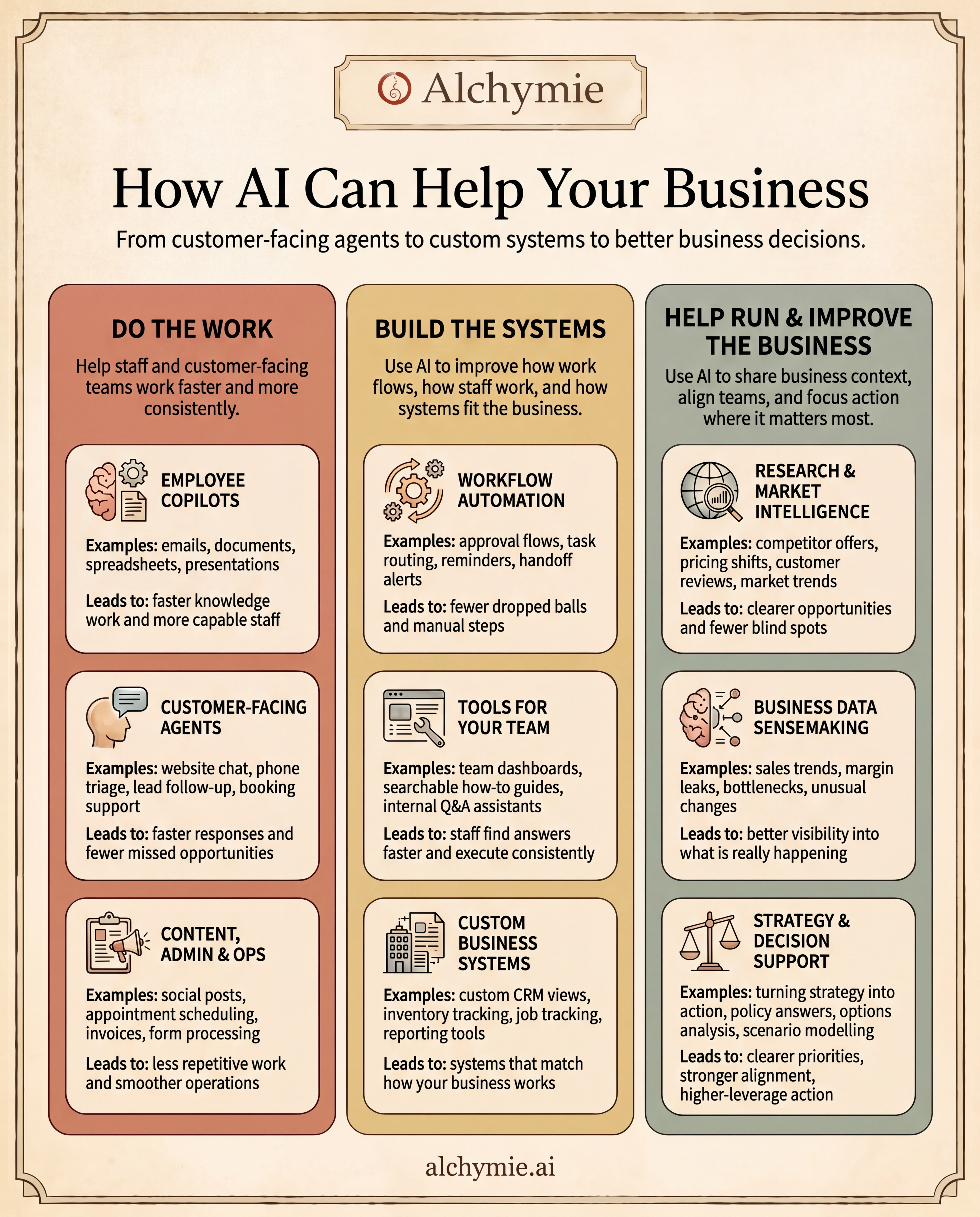
Once the problem is clear, AI becomes much easier to think about. The infographic below is a menu of possible response patterns. It shows the broad ways AI can help a business once you know what problem you are trying to solve.
AI Is Not Just Chatbots
Chatbots are one visible form of AI, but they are not the whole picture. A chatbot mainly gives people a conversational interface. An AI agent can go further. In practical business terms, an agent can use context, data, instructions, and connected tools to help complete a task.
Some agents talk to customers. Some help employees. Some watch business data. Some build workflows or software. Some support owners and managers with research, options, tradeoffs, and scenario thinking.
That is the shift this infographic is trying to make clear. Instead of thinking "AI equals chatbot", it is more useful to ask: what kind of work, system, or decision could AI help with?
Start With The Problem
The most important principle is simple: do not start with the tool. Start with the business problem. AI adoption works best when it is tied to a real business constraint.
That constraint might be operational:
- customers wait too long for a response
- staff spend too much time on repetitive admin
- work falls between systems or departments
- information has to be copied manually between tools
It might be strategic:
- the owner lacks visibility into what is really happening
- decisions are being made from partial information
- staff do not have a shared understanding of priorities
- market signals are being missed
Or it might be a growth constraint: the business has outgrown its systems, customer experience depends too heavily on individual staff, or new services are possible but the data and systems are not ready yet.
Once the problem is clear, the next question is not which AI product to buy. The better question is: what kind of AI response fits this problem?
Three Ways AI Can Help
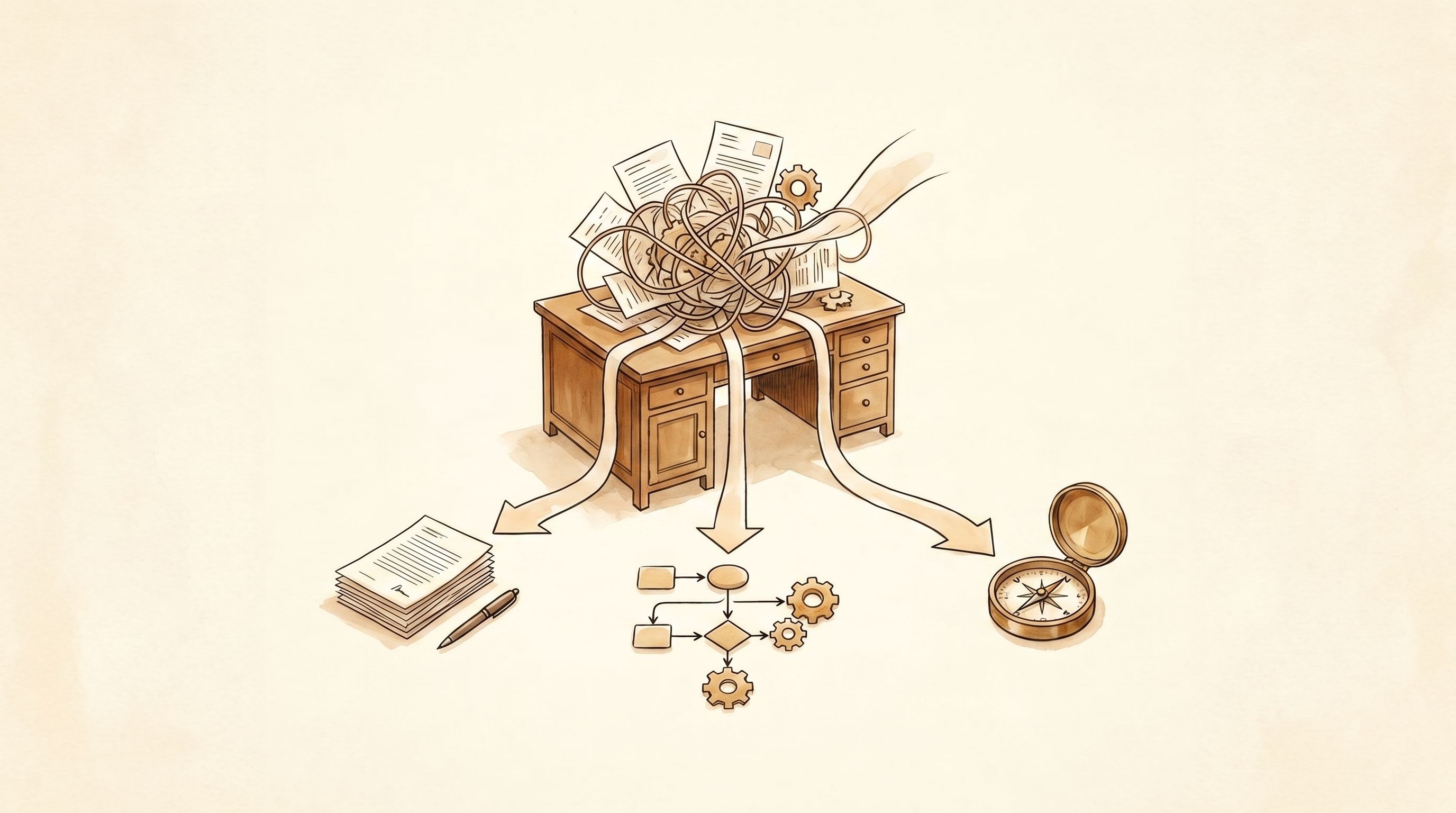
At a practical level, AI helps businesses in three broad ways.
- AI can do the work.
- AI can build the systems that do the work.
- AI can help run and improve the business.
These are not rigid categories. Real solutions often combine all three. But the model gives business owners a useful way to make sense of the landscape.
A quick way to read the map
Look for the shape of the problem first, then choose the response pattern.
Repetitive or document-heavy work
AI can do the work
Drafts, summaries, customer replies, reports, notes, and routine task streams move faster.
Predictable handoffs and manual steps
AI can build the system
Automations, internal tools, dashboards, and workflows reduce dropped balls.
Weak visibility, alignment, or prioritisation
AI can help run and improve the business
Shared context, clearer signals, and better decisions turn strategy into action.
1. AI Can Do The Work
This is the most familiar and immediate category. AI can help complete work that people would otherwise spend time doing directly. That does not always mean fully replacing a human. Often it means helping staff move faster, reducing repetitive work, or handling first-pass tasks before a person reviews the result.
Employee Copilots
For many businesses, the simplest starting point is helping employees do everyday knowledge work. AI can help staff create emails, documents, spreadsheets, presentations, meeting summaries, client notes, and reports.
This matters because much of modern work is file creation, communication, and synthesis. If AI helps people produce better first drafts, find information faster, and prepare work more quickly, the team becomes more capable without immediately changing the whole operating model.
Customer-Facing Agents
AI can also interact directly with customers: website chat, phone triage, lead follow-up, booking support, common questions, and appointment reminders.
Customer response is often a major value leak. Slow replies lose leads. Missed calls lose bookings. Poor follow-up loses opportunities that were already in the pipeline. A well-designed customer-facing agent can improve response speed, consistency, and availability while still escalating to a human when judgment or care is needed.
Content, Admin, And Operations
AI can also help with recurring business task streams: social posts, appointment scheduling, invoices, form processing, data entry, and routine internal updates. This is different from an employee using AI as a personal copilot. It is closer to AI supporting a recurring business process.
The business value is straightforward: less repetitive work, smoother operations, and more time returned to the team.
2. AI Can Build The Systems
This is the category many business owners do not yet fully see. AI does not only do work directly. It can also help design, build, and improve the software, automations, and internal tools a business needs.
This matters because many businesses are not constrained by a lack of effort. They are constrained by systems that no longer fit how the business actually works.
Workflow Automation
Some problems are best solved by connecting systems and removing manual handoffs. Examples include approval flows, task routing, reminders, handoff alerts, status updates, and follow-up sequences.
This kind of automation is especially useful when the process is predictable. If the steps are clear and repeatable, software should execute them reliably. The goal is fewer dropped balls and fewer manual steps.
Tools For Your Team
AI can help create team dashboards, searchable how-to guides, internal Q&A assistants, reporting views, and lightweight staff tools. These help employees find answers, understand priorities, and execute more consistently.
Custom Business Systems
Some businesses eventually need systems shaped around how they actually operate: custom CRM views, inventory tracking, job tracking, reporting tools, and bespoke workflow layers. Generic software is useful, but it often forces the business to adapt to the tool. Custom systems adapt the technology to the business.
3. AI Can Help Run And Improve The Business
The third category is where AI becomes more strategic. AI can help a business understand itself, see what is changing, and make better decisions. This is not just analytics. It is about creating better business context.
Research And Market Intelligence
AI can help monitor competitor offers, pricing shifts, customer reviews, market trends, and industry changes. Most businesses do not lack signals. They lack time to collect, interpret, and act on those signals.
Business Data Sensemaking
AI can also help make sense of internal data: sales trends, margin leaks, bottlenecks, unusual changes, and performance patterns. Many businesses have more data than they use. Reports exist, but nobody has time to read them. Dashboards exist, but nobody turns them into action.
Strategy And Decision Support
AI can help turn strategy into action by giving people access to shared business context: policy answers, options analysis, scenario modelling, and decision tradeoffs.
Done well, AI can help everyone in the business understand priorities, apply policies consistently, and make decisions in a way that is aligned with the larger direction. The goal is not just faster decisions. It is clearer priorities, stronger alignment, and higher-leverage action.
Agent, Automation, Or Hybrid?
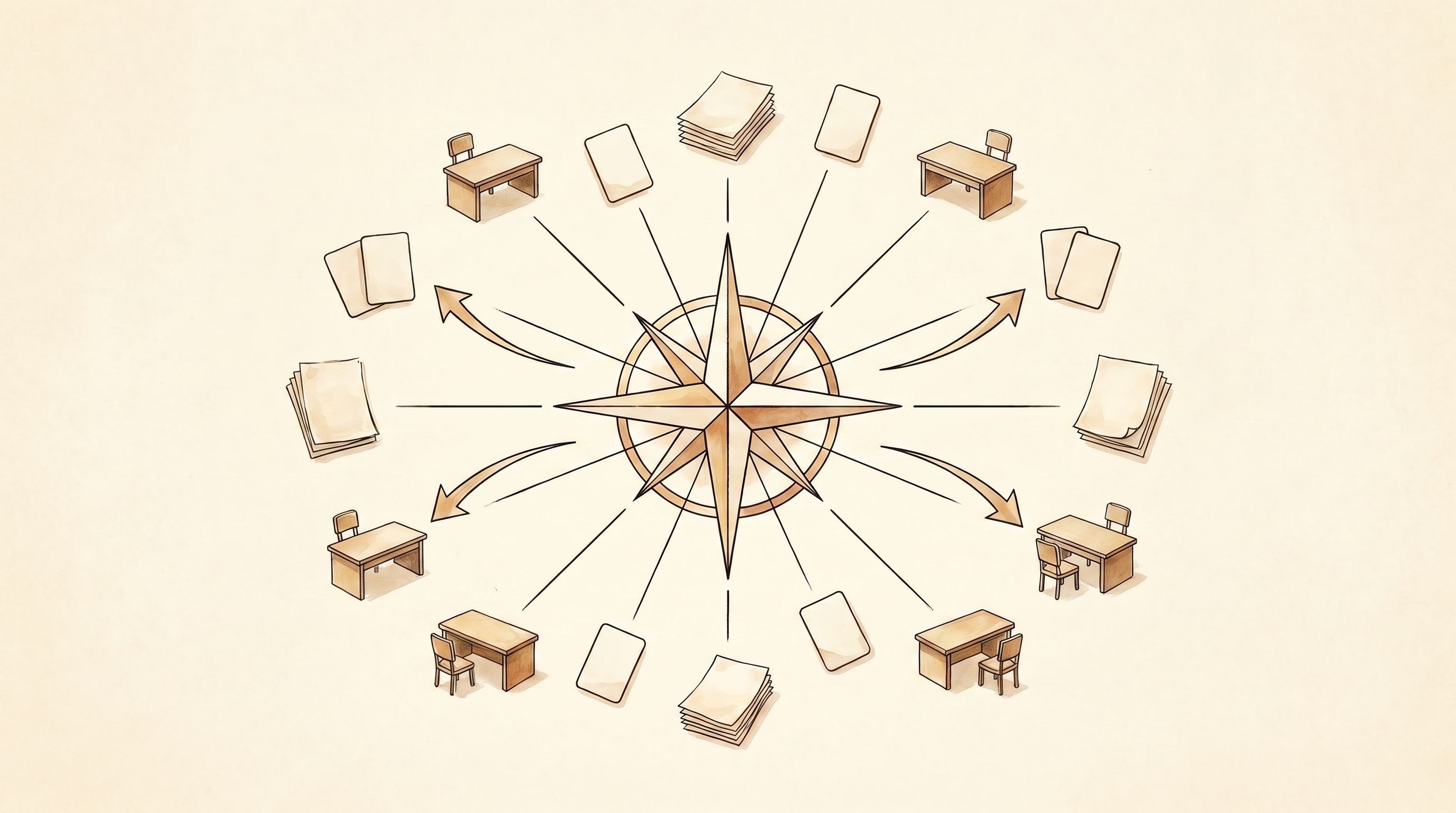
Not every problem needs an AI agent. This distinction matters.
- Use software automation when the inputs are structured, the rules are stable, and the steps are repeatable.
- Use an AI agent when the inputs are messy or language-heavy, judgment is required, or the system needs context.
- Use a hybrid system when AI should interpret the situation and software should execute the reliable steps.
Many strong business systems are hybrid. A customer-facing agent might understand the enquiry, classify the need, and draft the response. A workflow automation might update the CRM, trigger the booking sequence, and notify the right person. A human might step in when the situation is sensitive or high value.
The goal is not to add AI everywhere. The goal is to choose the right response for the business problem.
Where Should You Start?
The first AI project should not be the most futuristic one. It should be the first move that creates visible value.
At Alchymie, we look for starting points where several things come together:
- clear business pain
- measurable value
- practical feasibility
- adoption readiness
- a useful path to the next layer
That might mean starting with a customer-facing agent because leads are being missed, workflow automation because staff are coordinating too many manual handoffs, employee copilots because the team is drowning in documents, or business data sensemaking because the owner cannot see where margin, time, or opportunity is leaking.
The right starting point depends on the business.
The Larger Roadmap
This is where the infographic connects to Alchymie's broader services model. AI adoption is not one project. It is a roadmap. The services page unpacks that roadmap across operations, decision-making, and offer development.
We think about that roadmap in three layers:
- Surface: how you operate
- Middle: how you decide
- Foundation: what you offer
Most businesses begin at the Surface layer. As AI begins to handle more operational work, the business starts to generate better data and clearer signals. That opens the Middle layer: better visibility, better decisions, and stronger alignment.
Over time, when the business has better systems and better intelligence, the Foundation layer becomes possible. This is where AI can change what the business offers, not just how efficiently it operates.
You do not need to transform everything at once. But it helps to understand the larger path so the first move builds toward something coherent.
How Alchymie Helps
Alchymie helps businesses move from possibility to practical adoption. That starts with understanding how work actually gets done, where value is leaking, what systems are already in place, where staff are overloaded, what customers experience, and what decisions are being made without enough visibility.
From there, the work is choosing the right intervention. Sometimes that is an AI agent. Sometimes it is workflow automation. Sometimes it is a custom internal system. Sometimes it is training, adoption support, or a clearer strategy before anything is built.
The point is not to use AI for its own sake. The point is to make the business more capable.
Next Step
Use the infographic as a map. Look across the three columns and ask:
- Where are we losing time?
- Where are customers waiting or dropping out?
- Where are staff repeating low-value work?
- Where are systems not fitting how we operate?
- Where do we lack visibility?
- Where is strategy not turning into action?
Those questions usually reveal the best place to start. If you want help identifying the highest-value AI opportunity in your business, Alchymie can help you map the problem, choose the right response, and build the first move in the right order.